
Marine FSW for Stiffened Panels & Integral Structures
Table of Contents
- Why FSW Fits Marine Stiffened Panels and Integral Structures
- Design and Material Decisions for Stiffened Aluminum Panels
- Selecting 5xxx and 6xxx Aluminum Grades
- Panel Geometry and Joint Preparation
- Tooling and Machine Requirements for Large Marine Panels
- Tool Selection for Stiffened Panels
- Machine Selection by Panel Size and Section Depth
- Fixturing, Backing, and Process Control
- Controlling Distortion, Corrosion, and Fatigue Performance
- Distortion and Residual Stress
- Corrosion Resistance
- Fatigue and Structural Life
- Qualification, Inspection, and Production Economics
- Welding Procedure Qualification
- Non-Destructive Examination
- Production Economics
- Discuss Your Marine FSW Project with AEE
- Frequently Asked Questions
- Is FSW accepted for marine aluminum structures?
- Which aluminum alloys are most suitable for marine FSW panels?
- Can FSW weld hollow stiffened panels without back-side support?
- What panel sizes can FSW machines handle?
- How is marine FSW quality verified?
- References
Stiffened aluminum panels are increasingly specified for deckhouses, bulkheads, deck plating, and large flat ship structures because they combine low weight, high rigidity, and marine corrosion resistance. Friction stir welding (FSW) is a solid-state joining process in which a rotating non-consumable tool plasticizes the material without melting it, producing a joint below the parent-metal melting point [1]. For marine fabricators, that distinction matters: FSW reduces the porosity, hot cracking, alloy vaporization, and high distortion that complicate fusion welding of 5xxx and 6xxx aluminum alloys.
Why FSW Fits Marine Stiffened Panels and Integral Structures
Marine panel production benefits from FSW in three ways: lower heat input, fewer process steps, and joint geometry that supports stiffened profiles. Because the material remains below the solidus, heat-affected zone softening in work-hardened 5xxx alloys is much less severe than in gas-metal arc welding. That helps retain tensile properties in 5083-H321 and 5383-H116 plate. The process also creates a smooth, full-penetration butt joint with minimal root and crown reinforcement when tool control is correct.
Integral structures take this further. Instead of welding many separate stiffeners to a thin plate, designers use wide extruded profiles with integral ribs, bulb flats, or multi-void cross-sections. FSW can join these extrusions into larger panels with fewer weld meters and better dimensional stability. The result is a structure that behaves more like a continuous plate and less like an assembly of parts.
Design and Material Decisions for Stiffened Aluminum Panels
Selecting 5xxx and 6xxx Aluminum Grades
For unpainted hull, deck, and bulkhead applications in salt water, 5xxx alloys are preferred. Grades such as 5083, 5383, and 5754 are commonly supplied to ASTM B928/B928M for marine service [2]. The H116 and H321 tempers provide good corrosion resistance and stable mechanical properties. For extruded profiles, 6xxx alloys such as 6005A, 6061, and 6082 offer better extrudability and are often chosen when the panel will be painted or top-coated. Mixing 5xxx plate with 6xxx extrusions is possible, but galvanic and filler compatibility should be checked.
| Requirement | 5xxx alloys | 6xxx alloys |
|---|---|---|
| Unpainted marine corrosion | Excellent | Good, usually painted |
| Extrudability | Good | Excellent |
| Typical applications | Decks, hulls, bulkheads | Superstructures, profiles |
| FSW compatibility | High | High |
Panel Geometry and Joint Preparation
Good FSW panel design reduces weld length and improves access. Wide hollow extrusions with integral stiffeners can eliminate many fillet welds. Butt joints between plates or extrusions should maintain tight fit-up and consistent thickness across the seam. Edge preparation is simple compared with fusion welding: no bevel or filler is required, but flatness, cleanliness, and clamping gap control directly affect joint quality.
5xxx and 6xxx marine grades require different weld-development paths. <AEE provides customer with optional features FSW tool> covers how joint-specific tooling is matched to alloy and thickness.
Tooling and Machine Requirements for Large Marine Panels
Tool Selection for Stiffened Panels
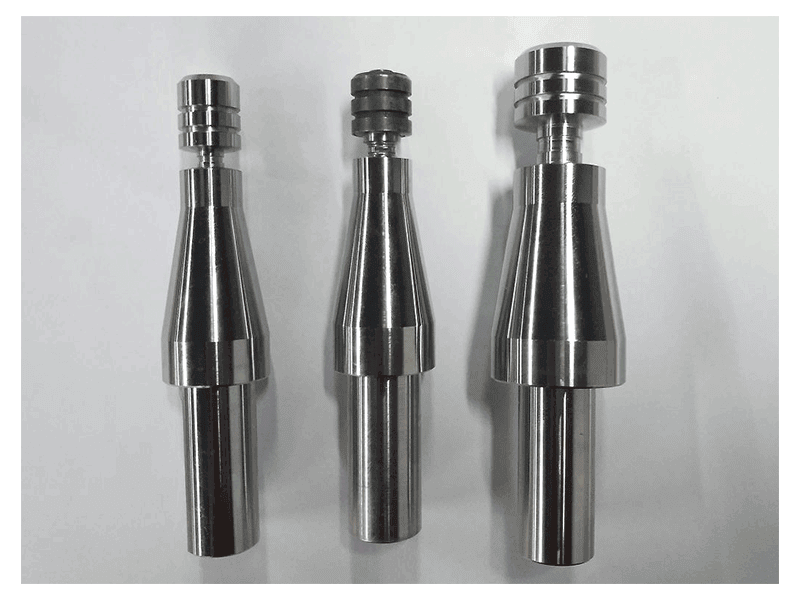
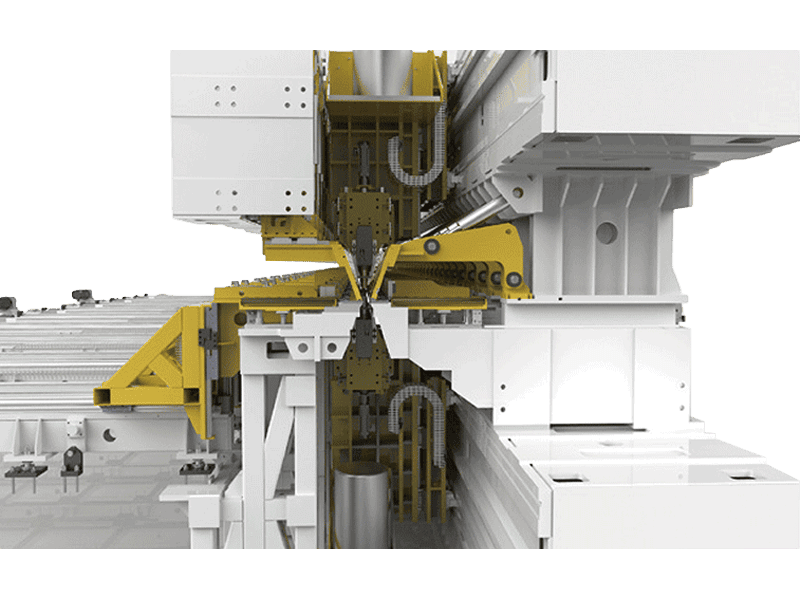
Most marine butt welds in 4 mm to 25 mm aluminum are produced with a conventional FSW tool, which offers strong process stability and broad alloy compatibility. For hollow profiles or closed sections without reverse-side support, a bobbin FSW tool welds from both surfaces simultaneously and eliminates root lack-of-penetration risk. Thin-wall panel skins may benefit from a stationary shoulder FSW tool, which reduces flash and creates a smoother crown surface.
Machine Selection by Panel Size and Section Depth
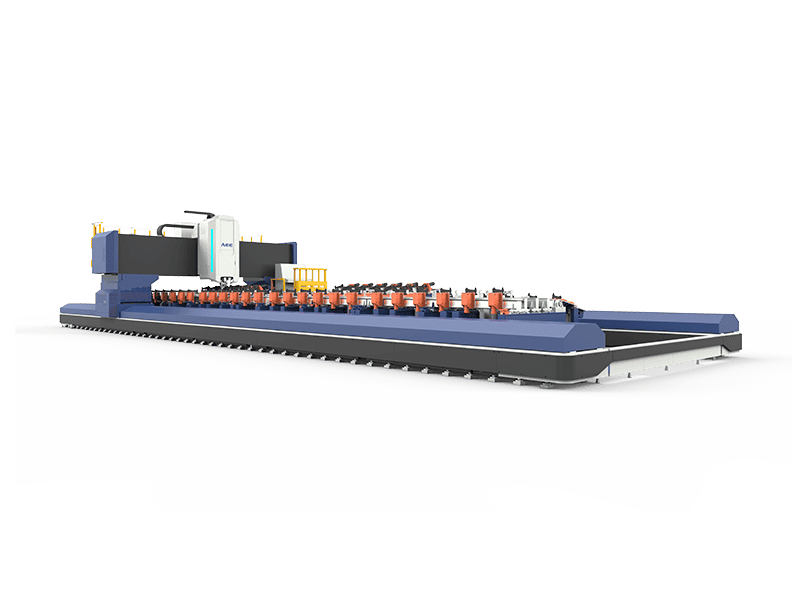
Long straight deck seams are produced on an extra-length straight profile FSW machine with extended X-axis travel and a rigid bed. For thick stiffened panels and heavy section assembly, a heavy-load FSW machine provides high spindle torque and large Z-axis force capacity. AEE heavy-load systems can perform single-side aluminum welding up to 100 mm, which supports demanding hull and structural applications.
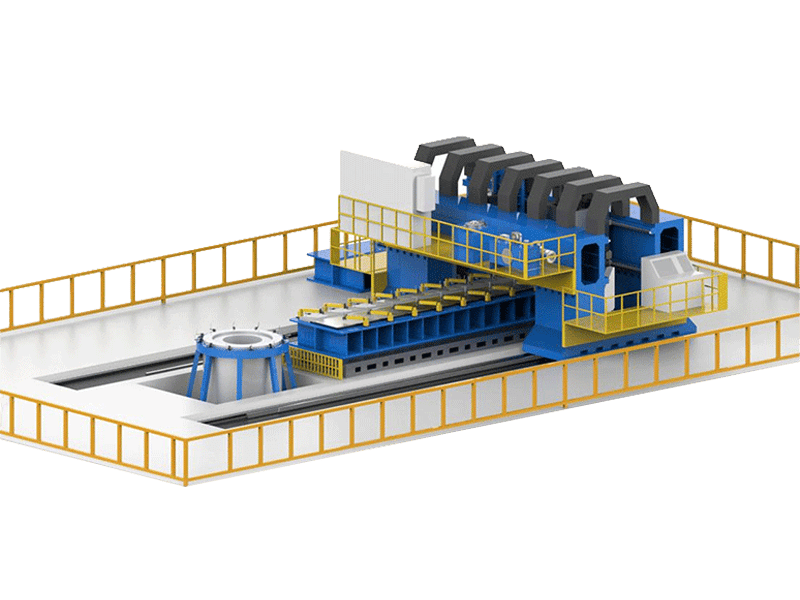
For shipyards planning series production of wide aluminum profiles, a fully automatic double-head FSW production line combines laser tracking, automatic clamping, double-sided welding, and process data logging. This type of line is suited to deck modules, long bulkhead panels, and prefabricated accommodation units where repeatability and throughput determine cost.
Fixturing, Backing, and Process Control
Stable clamping and a flat backing bar are critical for stiffened panels. The backing bar supports axial force, conducts heat, and prevents root collapse. Vacuum or mechanical fixtures hold the workpiece while allowing thermal expansion. Machines with force and position control can maintain consistent plunge depth over long seams, reducing the risk of local thinning or lack of penetration.
Engineering support for marine panel qualification: send your extrusion cross-section, alloy grade, panel width, and target classification requirements to [email protected] for a process feasibility review. Direct inquiry: +86 18325808715.
Controlling Distortion, Corrosion, and Fatigue Performance
Distortion and Residual Stress
Compared with fusion welding, FSW inputs less total heat, but long marine panels still require disciplined clamping and sequencing. Symmetric tool designs, bobbin tools, and controlled backing-bar temperature reduce angular distortion and panel bow. Post-weld measurements with laser scanning or a flatness check should be part of the acceptance plan. Reducing distortion at the source is usually less expensive than straightening a completed panel.
Corrosion Resistance
For 5xxx alloys in long-term marine service, sensitization is managed through temper selection and supplier quality verification. The standard laboratory method for assessing susceptibility to intergranular attack is ASTM G67 [3]. Marine fabricators should specify H116 or H321 tempers and validate the actual plate lot. FSW supports corrosion performance by eliminating filler-metal mismatch and by producing a narrow heat-affected zone compared with arc processes.
Fatigue and Structural Life
FSW butt joints perform well under cyclic loading when root flaws and surface-breaking defects are controlled. Bobbin or stationary shoulder tooling further reduces surface stress concentrations. Classification acceptance for marine aluminum structure typically requires procedure qualification, mechanical testing, and inspection to be documented and accepted by the responsible society.
Qualification, Inspection, and Production Economics
Welding Procedure Qualification
Marine aluminum FSW should be qualified with a written procedure that defines tool design, rotation speed, travel speed, plunge depth, forging force, tilt angle, and backing arrangement. Procedure qualification records can be structured according to ISO 25239-4 [4] and the approval requirements of the responsible classification society [5]. The qualification test should include macro examination, tensile testing, bend testing, and, where cyclic loading is critical, fatigue or structural testing.
Non-Destructive Examination
FSW weld quality is assessed with visual inspection, phased-array ultrasonic testing, radiographic testing, and penetrant testing. Because FSW leaves a smooth crown and no weld bead, ultrasonic interpretation benefits from reference blocks matched to the actual tool shoulder profile. Surface flash, lack of fill, wormholes, and root flaws are the main features to reject.
Production Economics
The economic case for FSW in marine fabrication comes from fewer weld passes, no filler metal, no gas or fume extraction, lower rework, and higher automation. A long-panel automatic line reduces labor and improves traceability. Although the initial tooling and fixture investment is higher than manual arc welding, series production of large panels typically recovers those costs through repeatable quality and reduced post-weld correction.
Discuss Your Marine FSW Project with AEE
Email [email protected] or call +86 18325808715 with the following project information:
- Extrusion or plate drawings and alloy/temper
- Panel length, width, and maximum weld thickness
- Section geometry and access to the reverse side
- Target production volume and cycle time
- Classification society and acceptance criteria
An engineering review can clarify process feasibility, machine platform, tooling strategy, and qualification plan before investment.
Frequently Asked Questions
Is FSW accepted for marine aluminum structures?
Yes. FSW can be qualified under applicable welding procedure standards and accepted by classification societies when the required testing, WPS, and inspection documentation are submitted and approved [5]. Acceptance criteria should be agreed with the responsible society early in the project.
Which aluminum alloys are most suitable for marine FSW panels?
5xxx alloys such as 5083, 5383, and 5754 are common for unpainted marine structures. 6xxx alloys such as 6005A, 6061, and 6082 are used for extruded profiles and painted superstructure components. The best choice depends on service environment, joint design, and whether the panel is external or internal.
Can FSW weld hollow stiffened panels without back-side support?
Bobbin tool FSW can weld from both sides of the workpiece simultaneously, making it suitable for hollow profiles and sections where the reverse side is difficult to access. It helps eliminate root lack-of-penetration and allows self-reacting welds without a rigid backing bar.
What panel sizes can FSW machines handle?
Long-panel FSW systems are available with stroke lengths exceeding 16 m and worktables several meters wide. Heavy-load machines can handle thick aluminum sections, while fully automatic lines support long, wide aluminum profiles for series shipbuilding. Machine selection depends on panel length, width, thickness, and production volume.
How is marine FSW quality verified?
Visual inspection, phased-array ultrasonic testing, radiographic testing, and penetrant testing are used. Destructive tests such as tensile, bend, and macro examination are part of procedure qualification. Fatigue testing may be added when cyclic loading is critical [4].
References
- ISO 25239-1:2020, Friction stir welding — Aluminium — Part 1: Vocabulary.
- ASTM B928/B928M-15, Standard Specification for High Magnesium Aluminum-Alloy Sheet and Plate for Marine Service and Similar Environments.
- ASTM G67-18, Standard Test Method for Determining the Susceptibility to Intergranular Corrosion of 5XXX Series Aluminum Alloys by Mass Loss After Exposure to Nitric Acid (NAMLT Test).
- ISO 25239-4:2020, Friction stir welding — Aluminium — Part 4: Specification and qualification of welding procedures.
- DNV Rules for Classification: Ships, Part 2 Materials and Welding, Chapter 4 Fabrication and Testing.
If you’re interested, check out these related articles:
Customized Dissimilar Material Welding Manufacturers in China
AEE provides customer with optional features FSW tool
AEE attend 13th International Symposium on FSW in Kyoto, Japan on 21 – 23 May 2024
Refill Friction Stir Spot Welding (RFSSW)