
FSW Machine Cost Breakdown: What Drives the Final Quote
Table of Contents
- Why two FSW machine quotes for the same part rarely match
- Matching machine class to the parts you actually weld
- Tooling cost and why it is a per-meter number
- What installation adds to the project budget
- Training and procedure qualification as budget lines
- Procedure development and qualification
- Operator and maintenance training
- How to build a per-weld cost model
- An RFQ structure that makes quotes comparable
- Send the part data for a scoped quotation
- FAQ
- Why is there no standard price list for FSW machines?
- Is tooling included in an FSW machine quotation?
- How long does installation and ramp-up take?
- Must welding procedures be qualified separately from machine acceptance?
- Can a lower-cost machine be upgraded later?
An FSW machine cost breakdown usually starts with the number at the bottom of the quotation, and that number is the least useful figure in the document. Two suppliers can quote the same table size and the same maximum thickness while the machines behind those quotes differ in spindle torque, force capacity, structural mass and control axes, which is where most of the cost sits. A defensible budget has five lines: equipment, tooling, installation, qualification and training. This breakdown explains what moves each line, which specifications you are actually paying for, and where a low price moves cost into your production later.
Why two FSW machine quotes for the same part rarely match
A buyer writes “8 mm aluminium, butt joint” in an enquiry and receives quotes with a wide spread. Margin explains part of the gap. Specification explains most of it, and the specification is invisible in a one-line enquiry.
Four characteristics carry the bulk of the machine cost. Z-axis force sets the frame section, guideway size and bearing class, and a 30 kN machine and a 200 kN machine are not the same structure scaled up. Spindle torque and power set the spindle frame, the cooling method and the tool holder interface, and the holder interface then sets the shank you must buy for every tool in the rack. Table area and stroke set structural mass, floor space and fixture size. Control axes and sensing set the controller, the number of servo drives and the software work, so a C-axis for circumferential welds, an A-axis for curved surfaces, force control, laser tracking, tool changing and monitoring each add a line to the build.
Maximum thickness is an output of those four, not an input. Two machines both rated at 8 mm can sit at opposite ends of a cost range when one is a compact C-frame and the other is a gantry with a C-axis and a large table.
| Spindle model | Welding thickness | Max speed | Power | Rated torque | Max force |
|---|---|---|---|---|---|
| AEE-S125 | 1 to 8 mm | 4000 rpm | 12 kW | 112 Nm | 30 kN |
| AEE-S119 | 2 to 12 mm | 4000 rpm | 25 kW | 208 Nm | 40 kN |
| AEE-S112 | 2 to 16 mm | 2500 rpm | 25 kW | 208 Nm | 50 kN |
| AEE-S065 | 2 to 25 mm | 2000 rpm | 31 kW | 257 Nm | 60 kN |
| AEE-S076 | 2 to 40 mm | 1500 rpm | 58 kW | 482 Nm | 80 kN |
| AEE-S064 | 2 to 100 mm | 1000 rpm | 105 kW | 874 Nm | 200 kN |
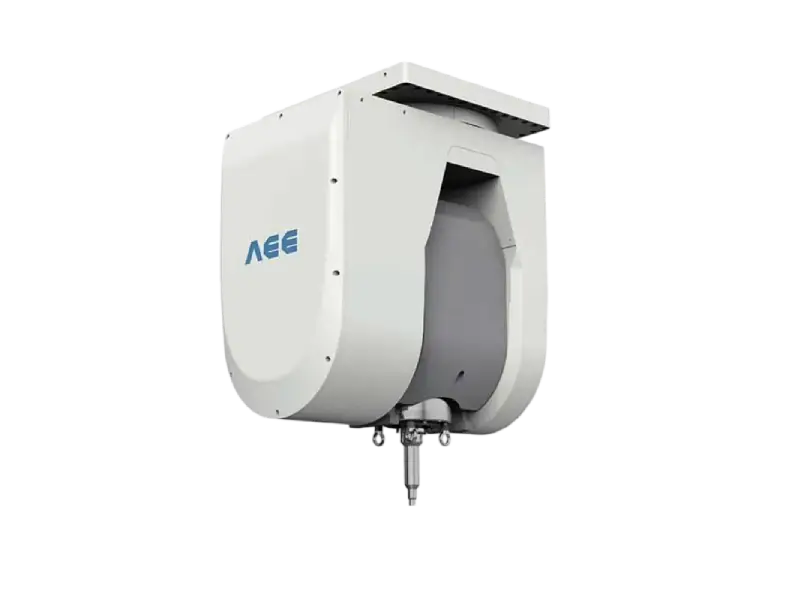
Read that table as a cost ladder. Moving from a 112 Nm spindle to an 874 Nm spindle multiplies torque by roughly eight and force by roughly seven, and the frame, holder and drive train grow with both. Speed moves the other way, from 4000 rpm down to 1000 rpm, because a large tool turning fast adds heat and torque the joint does not need.
These are published catalogue configurations from one manufacturer, not market prices and not a ranking against other builders. What they show is the direction of cost and the coupling between specifications. No supplier can hand over a price list that survives a real part drawing, and a number borrowed from another plant’s project is not a budget. What can be compared is the specification behind each price.
Matching machine class to the parts you actually weld
The cheapest machine that can weld your part is rarely the cheapest machine to own, and the most capable one is rarely the best value. Machine class should follow geometry and thickness first.
A C-frame handles small parts with flat or simple 2D contours: radiators, cold plates, small enclosures, motor housings. A 600 by 1200 mm table, 8 mm capability, a 12 kW spindle and 6,000 kg of machine weight keep the foundation and lifting work inside a normal factory bay. 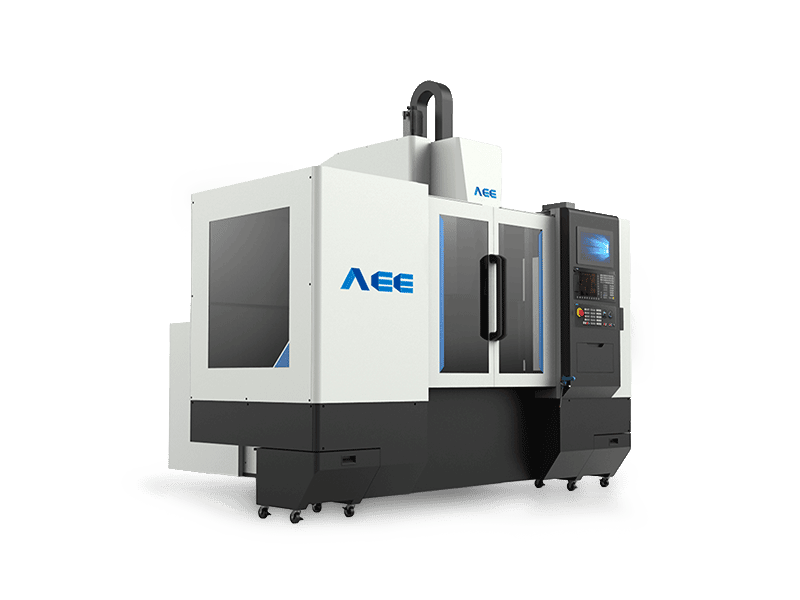
A dual-worktable version of the same class doubles the table area and rises to about 10,000 kg, and the cost shifts into fixtures and handling. Table count is not capability: the dual-worktable model is rated at 65 Nm, while the single-table C-frame in the same catalogue is rated at 112 Nm. If your joint needs the higher torque, two stations do not help.
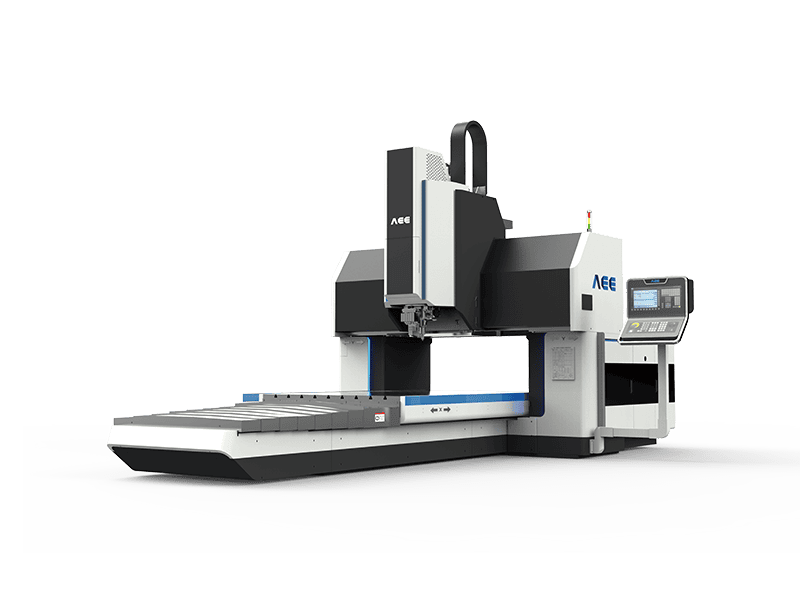
Gantry machines carry panels. A 2500 by 4000 mm table with 25 mm capability, a 31 kW spindle, 60 kN of Z-axis force and 30,000 kg of machine weight moves the cost discussion to floor loading, crane access and a building that can absorb the mass.
Extra-length machines solve length rather than thickness. A 16,000 mm X stroke with an 8 mm thickness rating and 75,000 kg of machine weight puts the money into a long, stiff bed and into rail alignment during installation, not into welding power. Rail and marine buyers often ask for process documentation aligned with rail welding qualification requirements, which is a project cost on top of the machine.
Heavy-load machines invert the pattern: 100 mm single-side aluminium, 35 mm copper, 200 kN of Z-axis force, a 105 kW spindle and 120,000 kg of machine weight. The cost lines that grow fastest are the foundation, the lifting plan and the electrical supply, not the tooling. 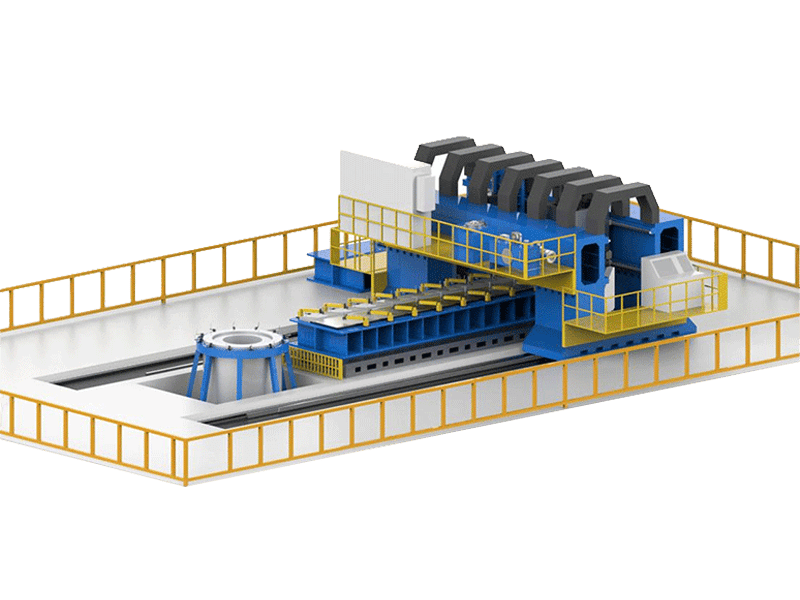
3D machines add A and C axes for curved geometry, in the 12 mm and 20 mm thickness classes, at roughly 35,000 kg and 55,000 kg of machine weight. Double-head machines and full production lines buy throughput rather than capability, through simultaneous welding, automatic loading and tool changing. A wheel production line quotes a cycle rate of 45 jobs per hour, and a double-head line for long profiles covers 1.2 to 16 mm thickness at up to 18.5 m of weld length. Those figures belong to a throughput case, and they only pay back against a volume that needs them.
| Published configuration | Spec basis | What it supports in a cost comparison | Do not infer |
|---|---|---|---|
| C-frame, 600 by 1200 mm table | 8 mm, 12 kW, 112 Nm, 30 kN Z force, 6,000 kg | Small parts and 2D contours keep foundation and lifting cost low | That low machine weight means low accuracy; positioning is stated at 0.03 mm |
| Dual-worktable C-frame | 8 mm, 15 kW, 65 Nm, 30 kN Z force, 10,000 kg | Cost moves into fixtures and handling to cut non-welding time | That two tables raise welding capability; torque is lower than the single-table model |
| Gantry, 2500 by 4000 mm table | 25 mm, 31 kW, 257 Nm, 60 kN Z force, 30,000 kg | Panel work shifts cost to floor loading and crane access | That a gantry frame guarantees tighter accuracy; positioning is stated at 0.05 mm |
| Extra-length, 16,000 mm stroke | 8 mm, 12 kW, 112 Nm, 30 kN Z force, 75,000 kg | Long welds put cost into bed stiffness and rail alignment | That a long machine also welds thick sections; thickness stays at 8 mm |
| Heavy load, 3000 by 8000 mm table | 100 mm aluminium, 35 mm copper, 105 kW, 872 Nm, 200 kN Z force | Thick plate puts cost into foundation, lifting and power supply | That 100 mm capability suits a 6 mm part, or that mass implies accuracy; positioning is stated at 0.05 mm |
| 3D, 12 mm class | 12 mm, 20.9 kW, 200 Nm, 40 kN Z force, 35,000 kg | Curved geometry adds rotary axes, programming and fixture cost | That rotary axes improve the economics of flat panels |
Treat those rows as one supplier’s published configurations rather than a market survey. Another builder may reach the same thickness with different force, mass or accuracy, and the comparison only holds when both quotes state the same four characteristics.
The over-specification tradeoff deserves a number in your own model, not a slogan. Buying 100 mm capability to weld 6 mm parts adds mass, foundation work, crane cost and connected load, and none of that improves the weld. Buying too little forces outsourcing or a second machine later, which usually costs more than the option would have. The decision belongs to the thickest joint you expect to quote in the next three years, not the thickest one you can imagine.
Dissimilar joints sit outside this scaling logic. Aluminium to copper or steel changes force, tooling and qualification requirements at the same time, and a configuration that welds 6XXX series comfortably may need a different tool and a new procedure for a dissimilar pair.
Joints between aluminium and copper or steel push force, tooling and qualification requirements in the same direction at once. <Customized Dissimilar Material Welding Manufacturers in China> covers customized dissimilar material welding supply.
Spot welding is a separate category with its own cost structure. A friction stir spot welding machine can be a robot-mounted unit or a desktop unit, and the tool sets the cycle, the surface finish and the post-processing burden rather than the table size.
Spot welding variants carry their own cost structure because the tool sets the cycle and the surface finish. <Refill Friction Stir Spot Welding (RFSSW)> covers the refill friction stir spot welding process.
Tooling cost and why it is a per-meter number
A tool is a consumable with a life measured in meters for a given alloy, thickness and parameter set. That makes tool cost a rate, not a purchase: tool price divided by life in meters, plus retipping or refurbishment, plus the holder share spread across its service interval. A quote that lists a tool price without a life basis cannot be compared with one that does.
Tool type changes both the consumable line and the work after welding. A conventional tool covers most standard structures in aluminium, magnesium and copper alloys. A retractable tool separates shoulder and pin so the pin retracts at the end of the pass and the exit hole closes, which removes a finishing operation on closed contours. A bobbin tool welds from both surfaces without rigid backing support, which removes backing plate cost and opens hollow profiles. A stationary shoulder keeps the shoulder from rotating, cuts heat input and flash, and suits thin walls and thick plate where surface quality matters.
Holders and fixtures belong in the same budget. A BT40 interface carries the lower-torque spindles and a BT50 or BT60 interface carries the high-torque ones, so the holder size follows the spindle you selected rather than your preference. Backing plates wear, grooves need maintenance, and fixture design determines how long clamping takes on every cycle.
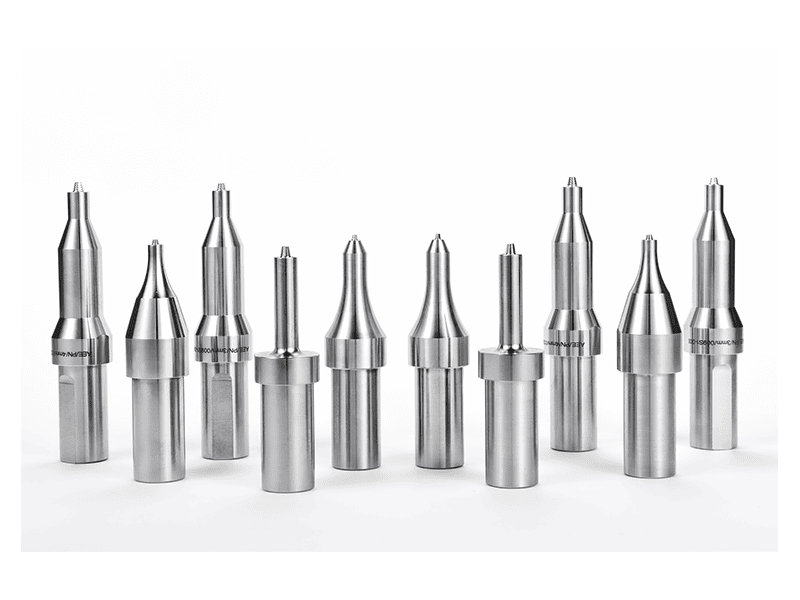
The sensitivity is worth stating plainly: if real tool life is half the figure you planned with, tool cost per meter doubles, and the machine price cannot compensate for it. Ask for tool life in meters per tool, per alloy and thickness, with the parameter basis, and confirm the retipping price and turnaround before you commit to a consumable budget.
Tooling choices change both the consumable budget and the amount of finishing work after welding. <AEE provides customer with optional features FSW tool> covers the optional tool features a buyer can specify.
What installation adds to the project budget
Installation is the line most often missing from a machine comparison, and it scales with mass and footprint rather than with price. Machine weight runs from about 6,000 kg for a compact C-frame to about 120,000 kg for a heavy-load gantry, with overall dimensions reaching 25,000 by 8,000 mm. That combination decides the foundation design, the load per support point, the lifting plan and the bay you need to keep free during commissioning.
Utilities follow the spindle and the structure. Connected load is not the spindle rating: a 12 kW spindle and a 105 kW spindle sit at opposite ends of the transformer, cable and cabinet discussion, and auxiliaries add to both. Compressed air is typically 0.4 to 0.8 MPa at about 1 m³ per minute through an 8 mm line. Water cooling appears on higher-load heads and on tool cooling for long welds. Extraction, ambient temperature and floor flatness all affect how quickly the machine reaches a stable process.
Leveling and alignment matter more as the bed gets longer. A 16 m X stroke machine has to be aligned across its full travel, and that work depends on the floor, the grout and the time allowed for the foundation to settle. Commissioning, the acceptance weld and the material for that weld are project costs too, not favors.
The check that prevents most surprises costs nothing. Send your building drawing and the utility data you have, and ask each supplier for load per support point, hook height and lifting weight, connected electrical load, air consumption, cooling water requirement, floor flatness tolerance and the acceptance test method. A supplier who cannot answer those in writing before the order will not resolve them during installation.
Training and procedure qualification as budget lines
Two different things are usually bundled under “training”, and they carry different costs.
Procedure development and qualification
A welding procedure has to be developed for your alloy, temper, thickness and joint configuration, then qualified by testing. Each combination is a separate procedure, so a product family that spans three thicknesses and two tempers is not one qualification. The cost sits in sample material, parameter trials, destructive examination such as tensile, bend and macro sections, any non-destructive testing your customer requires, and the engineering time to interpret the results.
If your customer is in rail, aerospace or a regulated pressure application, expect them to review the qualification package and to witness part of it. Their review time belongs in your schedule, and their acceptance criteria belong in the purchase specification rather than in a conversation after delivery.
Operator and maintenance training
Operator training covers setup, parameter recall, monitoring and first-line fault response. Maintenance training covers the tasks that decide uptime: tool and holder changes, spindle care, alignment checks, and reading the machine’s force, torque and temperature records. Training days are a weak comparison metric because they say nothing about what the trainee can do afterwards. Compare deliverables instead: whether your operators can load a qualified procedure and run a conforming part, and whether your maintenance team can change a tool holder and verify alignment without a service visit.
How to build a per-weld cost model
A per-weld model converts a set of quotations into one comparable number. In plain text:
Cost per weld = (equipment + installation + qualification, divided by planned welds) + (tool cost per meter × meters per weld) + (labor rate × cycle time) + fixture and backing amortization per weld + scrap and rework allowance
Each input has a source. Equipment, installation and qualification come from the quotation lines you insisted on separating. Planned welds come from annual volume multiplied by the years you intend to keep the machine. Tool cost per meter comes from the supplier’s life data or from your own trial. Cycle time comes from the same trial or from a demonstrated part. Scrap allowance comes from your own measurement, not from a supplier’s optimism.
Three inputs move the result more than the rest: tool life, cycle time and scrap rate. Doubling assumed tool life halves the consumable line, and a slower cycle adds labor and absorbed overhead to every part. Equipment amortization, the line buyers tend to debate longest, is mostly a division by planned welds, so the volume assumption does most of the work.
That is also where the in-house versus outsourced decision becomes decidable. At low volume, the amortized equipment line per weld stays high and an outsourced welding price can win on cost. At higher volume the same line falls, and tooling and cycle time become the deciding terms. Run the model with your own numbers for both cases rather than accepting either answer in advance.
One practical shortcut: choose a single unit, per meter of weld or per finished part, and convert every line to it. Mixing units is the most common reason two cost models disagree while both are arithmetically correct.
An RFQ structure that makes quotes comparable
Comparable quotations come from a specification, not from a request for a best price. The table below lists the cost lines to separate, and the comparison failure each one prevents.
| Cost line | Include in the RFQ | The comparison failure it prevents |
|---|---|---|
| Machine configuration | Z-axis force, spindle torque, power and top speed, table size and stroke, number of axes, positioning accuracy and repeatability | A lower-force machine looks cheaper and then cannot hold the joint |
| Tooling | Tool type and quantity, tool life basis per alloy and thickness, holder size, retipping price | Tooling left out of the machine price returns as an operating cost |
| Fixtures and backing | Who designs and owns the fixture, backing plate material, wear parts | Two quotes differ by a fixture one supplier expected you to build |
| Installation | Foundation and grout, lifting, utility connections, leveling, commissioning, acceptance weld | Site work is the line most often left unpriced |
| Qualification and training | Procedures to be qualified, specimen and laboratory costs, training content, documentation language | Equal training days hide different deliverables |
| Commercial terms | Warranty, spare parts list and lead times, freight, insurance, incoterms, payment, service response | Landed cost and downtime cost arrive after the comparison is closed |
A vague line and a usable line look like this.
Reject this RFQ line: “FSW machine for 8 mm aluminium, please send best price.”
Replace it with: “Aluminium 6061-T6, 4 mm to 6 mm, butt joint, 1.2 m weld length, 2D contour, and your stated annual volume; state Z-axis force, spindle torque, tool life in meters per tool, fixture scope, installation scope, qualification responsibility and the acceptance test method.”
Add one closing instruction to every enquiry: list what the price excludes. Suppliers who exclude nothing usually have not thought about installation, and the missing scope reappears as a change order after the purchase order.
Send the part data for a scoped quotation
Tell us the alloy and temper, thickness range, joint type, weld length, part size, annual volume, and the accuracy and surface requirement your product needs. With those inputs we can return a configuration, a tooling scope with a life basis, and a qualification and training plan priced as separate lines so you can put them into your own model. Aerospace Engineering Equipment (Suzhou) Co., Ltd. builds standard and customized FSW machines, production lines and tooling, and quotes machine, installation and training as distinct items. Email [email protected] or call +86 18325808715 with the drawing and the volume you expect.
FAQ
Why is there no standard price list for FSW machines?
Because the machine is built around a specification. Force capacity, spindle torque, table size, axis count, sensing and automation combine into a configuration that no two buyers order in the same way, and each combination changes the frame, spindle, drives and controller. A published list would either describe a machine nobody buys or mislead the buyer who compares against it. Ask for the specification behind each price, then compare the specifications.
Is tooling included in an FSW machine quotation?
Often only partially. Consumable tools, holders, fixtures and backing plates may be quoted separately, and tool life assumptions may not be stated at all. Request a tooling schedule with tool type, quantity, life in meters per alloy and thickness, holder interface and retipping price. Without that schedule the tooling line cannot enter a per-weld cost model, and the machine price comparison stays incomplete.
How long does installation and ramp-up take?
The schedule is set by your site as much as by the machine: foundation cure time, utility readiness, crane availability, sample material delivery, and the turnaround of qualification testing. Ask for a milestone schedule covering shipment, foundation, leveling, power and air connection, commissioning, acceptance weld, procedure qualification and operator sign-off, and mark which milestones depend on work you must complete. A supplier who cannot separate those dependencies has not planned the installation.
Must welding procedures be qualified separately from machine acceptance?
Yes, and they prove different things. Machine acceptance shows that the machine reaches and repeats the commanded position and force and produces a sound sample weld under agreed parameters. Procedure qualification shows that a joint made to a written procedure meets the mechanical and inspection requirements for that alloy, thickness and joint type. Both belong in the budget, and neither substitutes for the other.
Can a lower-cost machine be upgraded later?
Sometimes, and the limits are worth checking before you buy. Retrofit potential depends on controller and drive capacity, whether force control was fitted at build, whether a tool changer and safety guarding were prepared, and whether the frame has stiffness for higher force. A retrofit usually costs more than the factory option and may require a new acceptance test. If your volume or thickness range is expected to grow, price the option now.
If you’re interested, check out these related articles:
Refill Friction Stir Spot Welding (RFSSW)
Customized Dissimilar Material Welding Manufacturers in China
AEE provides customer with optional features FSW tool
AEE attend 13th International Symposium on FSW in Kyoto, Japan on 21 – 23 May 2024